
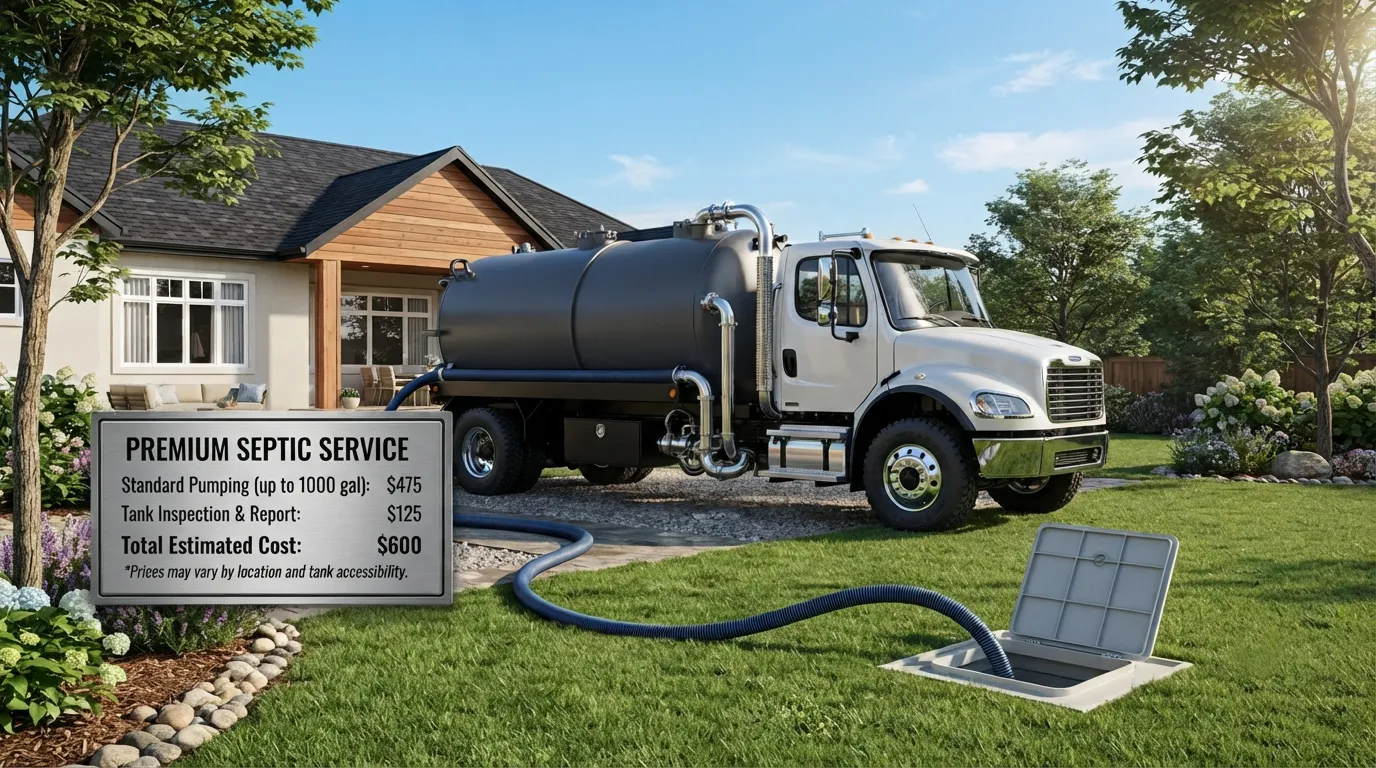
How Much Does Septic Tank Pumping Cost?
Most homeowners in Gilroy pay somewhere in that 150 to 300 dollar day-rate range for a routine pump-out, and where you land depends on tank size, how deep the lid sits, and whether the crew has to dig to find the access port. A 1,000 gallon septic tank, common under Gilroy houses built in the last few decades, sits at the typical end of that range in most cases. Tanks are generally pumped every 3 to 5 years, driven by household size and tank capacity, so this is not an annual bill for most families. If you are booking on a Saturday because that is the only day you are home, expect the weekend premium of 50 to 150 dollars instead of the weekday day rate. Gilroy Porta Pros quotes the job after a quick look at tank size and yard access, since a tank buried under a deck costs more labor than one with a clean lid at grade. For a full breakdown of what drives price up or down, see our septic tank pumping cost guide or the general septic pumping service page.
What Affects Septic Tank Cleaning Prices?
Tank size is the biggest lever. A 1,000 gallon tank costs less to pump than a 1,500 gallon commercial-grade tank, simply because there is more waste to remove and haul. Access matters almost as much: a lid at grade takes minutes to open, while a buried lid means digging first, and that adds labor time to the invoice. Distance from our yard plays a role too. Jobs closer to central Gilroy cost less to reach than calls out toward San Martin, 7.8 miles north, or further out toward Morgan Hill, 11.6 miles north. If your property also has a grease interceptor, note that those are pumped on a different schedule, once fats, oils, grease and solids reach 25 percent of the liquid depth, and that job is priced separately; see grease trap pumping for that service. Homes with older tanks or heavier household use sometimes need pumping closer to the 3-year mark rather than the 5-year mark, which shifts your long-run cost per year even if each visit is the same price.
| service | duration | low | typical | high |
|---|---|---|---|---|
| septic pumping | day | 150 | 250 | 300 |
| septic pumping | weekend | 50 | 100 | 150 |
How Often Does a 1,000 Gallon Septic Tank Need Pumping?
A residential septic tank, 1,000 gallons being the common size in Gilroy, is typically pumped every 3 to 5 years, with the exact interval driven by tank size relative to household size. A larger household or a smaller tank pushes you toward the 3-year end. A small household with a properly sized tank can stretch closer to 5 years. Skipping pump-outs does not save money in the long run. It just delays the bill and raises the risk of a backup, which usually costs more to fix than a scheduled visit would have. If you are not sure where your property falls, our how often to pump a septic tank page walks through the signs that tell you it is time, and septic tank warning signs covers what a failing tank looks and smells like before it becomes an emergency. For most Gilroy homeowners, setting a reminder on a 4-year cycle is a reasonable middle ground unless a plumber or inspector tells you otherwise.

Is Septic Pumping Different From a Holding Tank Rental?
Yes. Septic pumping empties an existing in-ground tank that is part of your home's plumbing. A holding tank rental is a separate unit brought onto a property, often for construction sites, events, or locations without sewer access at all. If your project needs wastewater capacity rather than a cleanout of an existing system, look at holding tank rental instead. Construction sites around Gilroy sometimes need both services at different points: septic pumping if there is an existing system on the property, and a rented holding tank if the crew needs temporary capacity during a build. For active job sites, pairing either option with a portable toilet rental or reviewing our broader construction site services makes sense, since OSHA 1926.51(c) sets toilet facility ratios for job sites based on worker count, separate from septic tank service entirely. If your situation involves an emergency, not a scheduled pump, check emergency septic service rather than waiting for a routine slot.
Can I Combine Septic Pumping With Other Site Services?
Yes, and many Gilroy customers do, especially during a renovation or a property sale where several systems get inspected and serviced at once. It is common to schedule a septic pump-out alongside a septic tank cleaning inspection, particularly if a home inspector flagged the tank during a sale. If your project also involves demolition or cleanup, a roll-off dumpster rental or a look at dumpster rental cost can be scheduled for the same week. Homeowners doing a larger renovation sometimes need a home renovation porta potty on-site too, if the household bathroom is out of service during the work. Coordinating these visits together often saves a trip charge compared to booking each service separately. For agricultural properties outside central Gilroy, note that field sanitation for hand-labor employees falls under OSHA 1928.110, which sets a different standard than a residential septic pump; see farm and agricultural restrooms if that applies to your operation.
How much does it cost to pump a 1,000 gallon septic tank?
A 1,000 gallon tank, the common size in Gilroy, typically falls in the 150 to 300 dollar day-rate band, landing near the middle of that range for most straightforward jobs with clear access to the tank lid.
How often should I have my septic tank pumped?
Every 3 to 5 years for a typical residential tank, with the exact timing set by tank size against household size. Larger households or undersized tanks should lean toward the 3-year end of that window.
Does tank access affect the price?
Yes. A lid sitting at grade is quick to open. A buried lid needs digging first, which adds labor time and raises the total cost of the visit compared to a job with clean access.
Is a weekend septic pump-out more expensive?
Yes. Weekend service carries a premium of roughly 50 to 150 dollars above the standard day rate, since it is scheduled outside the normal weekday route.
What is the difference between septic pumping and a grease trap service?
Septic pumping clears a home's wastewater tank on a multi-year cycle. A grease interceptor is pumped once fats, oils, grease and solids reach 25 percent of the liquid depth, which is a different trigger and a different service entirely.

Next step
Get a delivery date
Tell us the address, the dates and the headcount. We size the order and confirm the route.